Climate Technology & ESG
From Tree Planting to
Verified Environmental Impact
How Araynix is using AI, satellite intelligence, geospatial analytics, biodiversity monitoring, bioacoustics, and digital MRV to transform and environmental monitoring.
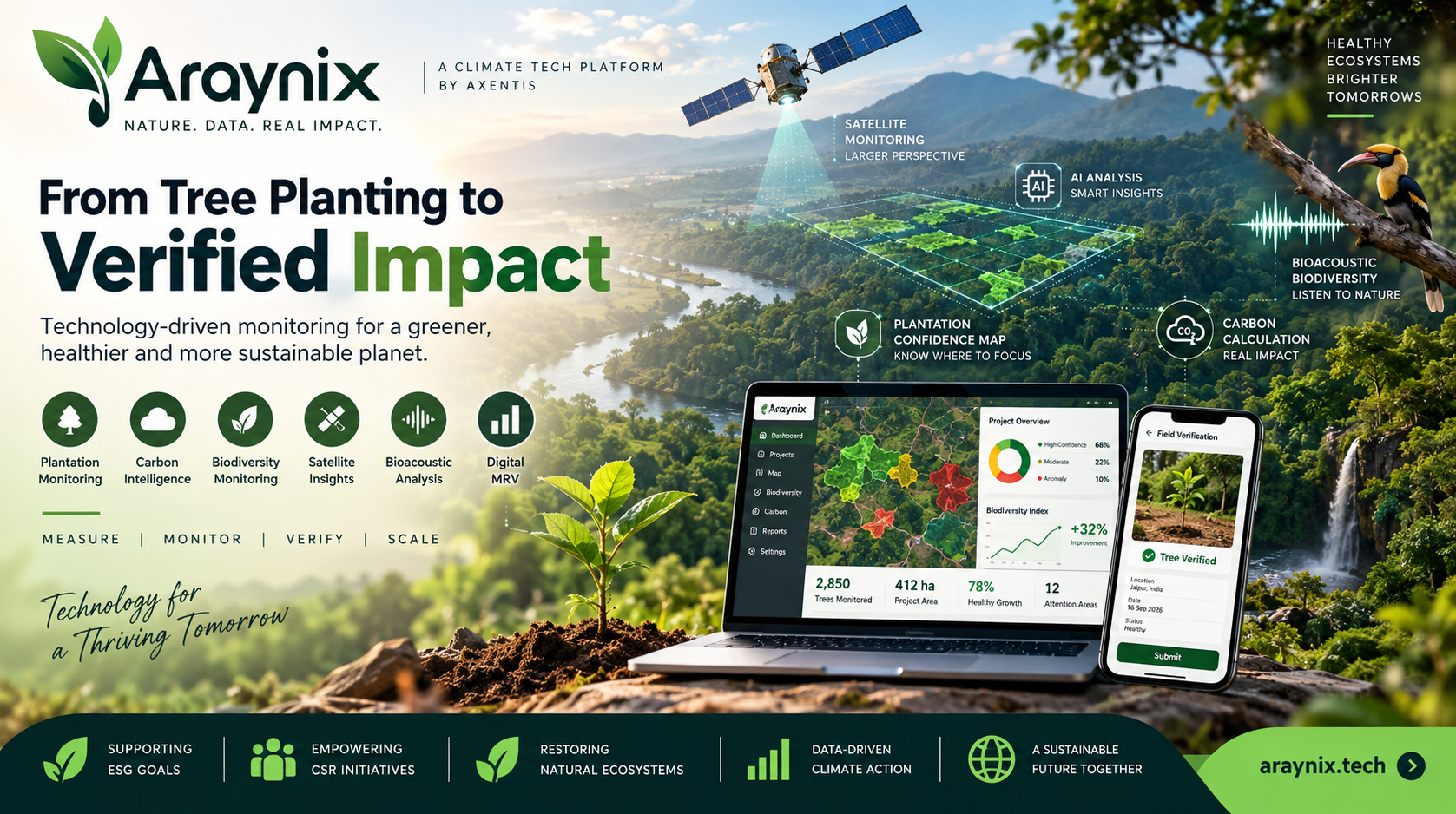
Climate Technology
Planting Trees Is Only the Beginning
Tree plantation is widely recognized as an important component of environmental restoration, climate action, biodiversity conservation, and corporate sustainability programs. But for organizations investing in plantation and restoration initiatives, one of the biggest challenges after the planting is completed.
How many trees were actually planted? Are they still surviving? Is the plantation developing as expected? Is the reported area consistent with what exists on the ground? Is biodiversity improving? Can the organization produce credible evidence to support its sustainability reporting?
These questions highlight an important distinction: plantation is an activity, while measurable environmental impact is the outcome.
Technology is increasingly becoming the bridge between these two. Modern climate technology platforms can combine satellite imagery, Artificial Intelligence, geospatial intelligence, biodiversity monitoring, field data, and digital evidence to create a more comprehensive approach to environmental Monitoring, Reporting and Verification (MRV).
The Challenge
Why Environmental Monitoring Needs to Go Beyond Photographs and GPS
Traditional plantation monitoring often depends on photographs, spreadsheets, GPS coordinates, periodic field inspections, and manually prepared reports.
These methods can provide valuable evidence, but they represent only individual pieces of a much larger environmental picture.
Photographic Evidence
Provides visual evidence from a particular location and point time, but may not explain long-term changes.
GPS Coordinates
Establish the location of an activity but do not by themselves demonstrate plantation health or ecological outcomes.
Spreadsheets
Organize project information but can become difficult to manage as projects and monitoring locations increase.
Periodic Inspections
Provide valuable ground-level verification but can be expensive and difficult to scale across large geographic areas.
A technology-driven monitoring system can combine these sources with observations, geospatial analytics, AI, and environmental intelligence to create a more connected evidence framework.
Introducing Araynix
A Digital MRV Platform for Environmental Intelligence
Araynix is a climate technology and MRV platform developed within the Axentis ecosystem to support plantation monitoring, carbon-related workflows, biodiversity monitoring, and environmental intelligence.
The platform brings multiple technology layers together to help organizations monitor environmental projects more systematically and create structured digital evidence around project activities.
Satellite Intelligence
Seeing Environmental Change at Scale
Environmental projects can cover hundreds or thousands of hectares, making continuous physical inspection difficult. Satellite data can provide an additional layer of visibility across large geographic area.
By combining project boundaries, geospatial datasets, and historical observations, technology platforms can help identify changes in vegetation and land conditions over time.
Plantation Monitoring
Monitor plantation areas and changes in vegetation over time.
Vegetation Assessment
Analyze vegetation-related indicators using geospatial data.
Change Detection
Identify changes that may require additional investigation field verification.
Environmental Risk Identification
Highlight locations where available evidence indicates potential environmental anomalies.
Satellite intelligence does not replace field verification. Instead, it can help organizations prioritize field activities and add another layer of evidence to environmental monitoring workflows.
Artificial Intelligence
Turning Environmental Data Into Actionable Intelligence
Environmental monitoring can generate significant volumes of data across locations, projects, time periods, and environmental indicators. Artificial Intelligence can help process this information and identify patterns that may be difficult to detect manually.
Pattern Detection
Identify meaningful patterns across environmental and
geospatial datasets.
Environmental Anomalies
Highlight locations where available evidence differs from
expected conditions.
Monitoring Prioritization
Help teams identify locations that may require additional monitoring or field investigation.
Decision Support
Convert large environmental datasets into information that supports better operational decisions.
Biodiversity Intelligence
Environmental Impact Goes Beyond Carbon
Climate and environmental programs are often discussed primarily through the lens of carbon. However, healthy ecosystems are much more complex than a single carbon metric.
Biodiversity, habitat quality, ecological activity, and species richness are important components of ecosystem health. This creates an opportunity for technology to provide a broader view of environmental impact.
Araynix incorporates biodiversity-focused monitoring into its intelligence approach, helping organizations look beyond plantation counts and consider ecological indicators as part of their monitoring framework.
Bioacoustic Intelligence
What If We Could Listen to the Ecosystem?
Forests and natural ecosystems generate a complex acoustic environment. Birds, insects, amphibians, and other organisms produce sounds that can provide valuable information about biological activity.
Bioacoustic monitoring introduces another dimension to environmental observation by analyzing ecosystem sounds alongside other environmental
data.
Audio-Based Monitoring
Capture short environmental audio recordings from monitored locations.
AI Species Detection
Use AI-based species recognition technologies to identify potential biological signals within recordings.
Biodiversity Indicators
Use detected species and acoustic observations as an additional layer of biodiversity information.
The objective is not to replace ecological surveys, but to create another technology-enabled source of environmental information that can complement field and geospatial observations.
Plantation Confidence
From Complex Data to a Plantation Confidence Map
Environmental monitoring can produce large volumes of information. Decision-makers, however, often need a simple way to understand where attention may be required.
Araynix uses the concept of a Plantation Confidence Map to represent outcomes in an intuitive way.
Evidence aligns with expected plantation conditions.
Additional monitoring or verification may be useful.
Available evidence indicates that further investigation may be required.
This type of visualization helps transform complex geospatial and analytical information into a decision-support layer for project managers and environmental teams.
Digital MRV
Building a Digital Evidence Chain
Monitoring, Reporting and Verification (MRV) is an important component of environmental and climate projects. Effective MRV can involve multiple types of information and evidence.
Project Boundaries
Maintain structured geographic information for environmental projects.
Plantation Records
Organize plantation activities and associated project information.
Field Evidence
Capture and organize ground-level observations and supporting evidence.
Satellite Observations
Integrate geospatial observations into project monitoring workflows.
Biodiversity Information
Bring biodiversity and bioacoustic observations into the monitoring ecosystem.
Reporting & Evidence
Organize project information for structured reporting and audit preparation.
Project → Activity → Monitoring → Evidence → Analysis → Reporting
Carbon Intelligence
Carbon Monitoring Needs Reliable Data
Carbon projects require appropriate methodologies, reliable data, monitoring processes, and verification. Technology can support the collection, organization, analysis, and reporting of project information.
A digital platform can assist with carbon-related workflows such as data management, project monitoring, calculations, evidence organization, reporting, and audit preparation.
Technology should be viewed as an enabler of better MRV rather than a replacement for independent validation, verification, certification, applicable standards and methodologies.
ESG & CSR
Bringing Environmental Programs Into One Digital Ecosystem
Organizations may manage environmental initiatives through CSR, ESG, sustainability, infrastructure, restoration, and community development programs. Managing information across multiple projects can become increasingly difficult as programs grow.
CSR Plantation
Monitor plantation programs, locations, evidence, and project progress through a centralized digital environment.
ESG Programs
Support environmental monitoring and sustainability reporting with structured digital evidence.
Forest Restoration
Monitor restoration activities and environmental indicators across geographic areas.
Biodiversity Programs
Combine biodiversity observations with broader environmental monitoring information.
Technology & ESG
How Technology Supports ESG
Environmental
Satellite monitoring, carbon data, biodiversity analysis, plantation monitoring, climate intelligence, and environmental risk assessment.
Social
Digital monitoring of CSR initiatives, community programs, stakeholder engagement, and social impact activities.
Governance
Digital evidence, audit trails, compliance workflows, reporting, data governance, and transparent project management.
Technology Stack
Technology Behind Environmental Intelligence
The Bigger Picture
From Environmental Monitoring to Environmental Intelligence
The real opportunity in climate technology is not simply collecting more data. It is transforming environmental data into information that organizations can understand and act upon.
A modern environmental intelligence platform should help answer fundamental questions:
This is the difference between simply maintaining an environmental database and building an environmental intelligence system.
Future of Climate Technology
The Future of Environmental MRV Is Multilayered
Environmental monitoring is unlikely to depend on a single technology. The next generation of climate technology will increasingly combine multiple evidence sources to create a more complete picture of environmental change.
Satellite Data
Provides geographic visibility across large and difficult-to-access areas.
Artificial Intelligence
Identifies patterns, anomalies, and insights within large datasets.
Field Applications
Capture ground-level observations and supporting evidence.
Bioacoustics
Adds an acoustic perspective to biodiversity and ecosystem monitoring.
Geospatial Analytics
Connect environmental observations with location intelligence.
Digital MRV
Organizes evidence, monitoring workflows, and reporting into a structured digital ecosystem.
Araynix by Axentis
Applying Advanced Technology to Real-World Climate Challenges
Araynix represents the application of Axentis’ technology capabilities to a specialized environmental challenge: helping organizations monitor and manage plantation, biodiversity, carbon-related, and environmental programs through digital technologies.
AI & Machine Learning
Intelligent analysis, anomaly detection, and environmental decision-support capabilities.
Geospatial Intelligence
Location-based environmental monitoring using GIS and satellite data.
Biodiversity & Bioacoustics
Additional ecological intelligence beyond conventional plantation monitoring.
Digital MRV
Structured environmental evidence, monitoring workflows, and reporting capabilities.
Conclusion
The Next Step Is Measuring What Happens After Planting
Environmental initiatives need more than good intentions. They need measurable outcomes, reliable evidence, continuous monitoring, and informed decision-making.
Technologies such as Artificial Intelligence, satellite intelligence, GIS, biodiversity analytics, bioacoustics, cloud computing, and digital MRV can help organizations build a more connected approach to environmental monitoring.
Araynix represents this shift from fragmented environmental reporting toward integrated digital environmental intelligence.
The future of climate technology is not simply about planting more trees. It is about building systems that help organizations understand, monitor, measure, verify, and improve what happens after planting.
Plant → Monitor → Measure → Verify → Analyze → Improve
About Araynix
Climate Technology for Measurable Environmental Impact
Araynix is a climate technology and digital MRV platform focused on plantation monitoring, carbon, biodiversity, and environmental
intelligence.
The platform brings together geospatial technologies, satellite monitoring, Artificial Intelligence, biodiversity monitoring, bioacoustic intelligence, environmental analytics, and digital evidence workflows to support organizations managing environmental projects at scale.
About Axentis Technologies
Building Technology Solutions for Complex Business Challenges
Axentis Technologies Pvt. Ltd. develops technology solutions across Artificial Intelligence, AI agents, custom software, mobile applications, blockchain, cloud, DevOps, and digital transformation.
Araynix demonstrates how these technology capabilities can be applied to a specialized real-world challenge: helping organizations create more structured and technology-driven environmental monitoring systems.
Exploring Technology for Climate & ESG?
Talk to Axentis about building intelligent digital solutions for monitoring, ESG, climate technology, data intelligence, digital transformation.
![]() 99%
Focused on delivering reliable and business-driven experiences
![]() 10+
Industries transformed through intelligent digital solutions and automation.
