Software Development Partner Guide
What Is a Paid Pilot Project, and Why Run One Before Committing to a Dev Partner?
Picking a software development partner is one of the harder calls a CTO, founder or product lead makes. Proposals look alike, and reference calls only tell you so much. A paid pilot project cuts through that. Instead of judging a partner on how they pitch, you judge them on how they deliver a real, bounded piece of your product.
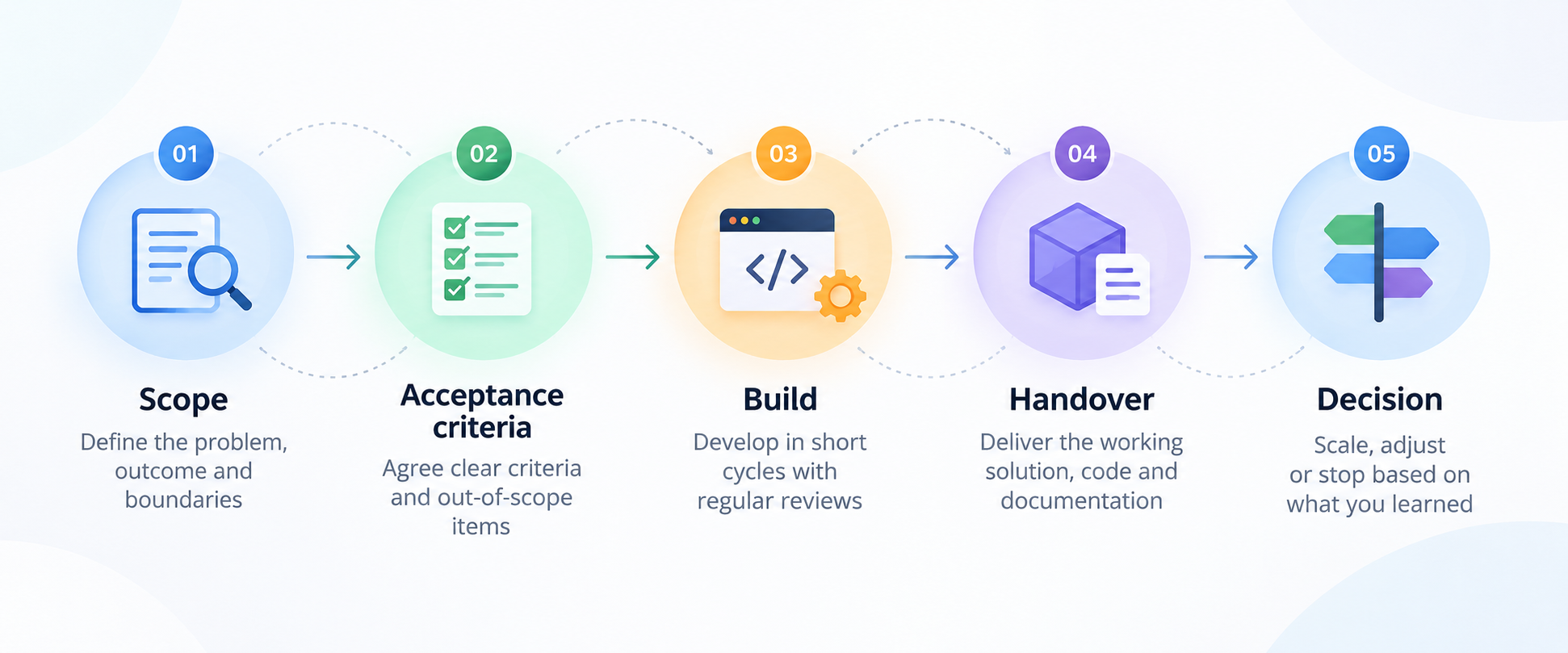
Introduction
Why Run a Paid Pilot Before Committing to a Development Partner?
Picking a software development partner is one of the harder calls a CTO, founder or product lead makes. Proposals look alike, and reference calls only tell you so much. A paid pilot project cuts through that. Instead of judging a partner on how they pitch, you judge them on how they deliver a real, bounded piece of your product.
This guide covers what a paid pilot is, how to pick and scope one, what to watch while it runs, and how it should end. It also shows how we structure our own Launch Pilot at Axentis, so you can compare it with whatever any vendor (including us) offers you.
Understanding Paid Pilots
What a Paid Pilot Is, and How It Differs From a Free Trial or a Demo
A paid pilot project is a short, fixed-scope engagement where a development partner builds something real for you, under real working conditions, before you sign a longer contract. You pay for it, you own what is built, and it ends with a clear decision.
It is easy to confuse with two other things:
A Demo
A demo shows what a vendor has already built for someone else, or a polished prototype. It tells you about their sales process, not about how they will handle your codebase, your stakeholders or your edge cases.
A Free Trial
A free trial sounds lower-risk, but the incentives are off. A team working for free will understandably put its best people on paying work. You also tend to get loose scope, no acceptance criteria and nothing you can really use afterwards.
A Paid Pilot
A paid pilot puts both sides under normal commercial terms. The partner commits a real team, and you commit real time from your product owner. Each side gets an honest look at the other.
Choosing the Right Pilot
Choosing the Right Pilot Outcome: Real, Bounded and Worth Shipping
The most common mistake is picking a pilot that is either too trivial to tell you anything or too big to finish. A good pilot outcome is:
Real
It solves an actual problem in your product or operations, not a throwaway exercise. If the pilot succeeds, you should want to keep what was built.
Bounded
It can be specified, built, tested and handed over within the agreed window, with clear edges on what is in and out of scope.
Representative
It touches the kind of work a longer engagement would involve: your stack, your integrations, your review process.
Pilot-Sized Outcomes
Examples of Pilot-Sized Outcomes
Web Feature or Internal Tool
A self-contained web feature or internal tool, such as a reporting dashboard or an admin workflow.
Mobile MVP Release Slice
A mobile MVP release slice: one core user journey shipped as a beta build to a test group, not a full public app-store launch.
Assistive AI Feature
An assistive AI feature where the model drafts, classifies or summarises and a person reviews and approves the output before anything is acted on.
CI/CD, Monitoring or Release Readiness
A CI/CD pipeline, monitoring or release-readiness improvement on an existing system.
Before Development
Writing Acceptance Criteria Before Any Code Is Written
Acceptance criteria turn “we built something” into “we built the right thing.” Agree them in writing before development starts, and make them specific enough that both sides could check them without arguing.
Good acceptance criteria usually cover:
Functional Behaviour
What a user can do, written as concrete scenarios. For example: “An approver can see pending requests, approve or reject each one, and the requester is notified.”
Quality Bar
Which browsers or devices are supported, what test coverage or automated checks are expected, and how defects found during the pilot are handled.
Non-Functional Basics
Reasonable performance for your context, basic security practices such as no secrets in code and access limited to the people who need it, and accessibility expectations where they apply.
Deliverables Beyond Code
Setup instructions, a short architecture note, and anything your team needs to run and change the work after handover.
Ownership
Code lives in repositories you control, and cloud resources sit in accounts you own or can take over.
Out of Scope
Also write down what is out of scope. New ideas should go into a backlog for after the pilot unless both sides agree to swap something out.
During the Pilot
What to Watch During the Pilot Besides the Deliverable Itself
The deliverable matters, but a pilot is just as much a test of how the partnership works. Pay attention to:
Communication Rhythm
Do you get regular, honest updates, including bad news, without having to chase? For teams in the US, UK, Canada or Australia working with an India-based partner, check that the agreed overlap hours actually happen and that questions don’t sit unanswered overnight.
How Questions Are Raised
A strong team flags unclear requirements early instead of guessing. Count how often you are surprised.
Visibility of Work in Progress
Can you see the code, the task board and builds as they happen, or only at the end?
Handling of Change and Problems
When something turns out harder than expected, do they explain the trade-offs and let you decide, or quietly cut corners?
Who Is Actually Doing the Work
The people on the pilot should be the people you would get in a longer engagement, not a hand-picked team that disappears afterwards.
Engineering Hygiene
Readable code, sensible commits, tests where agreed, and no shortcuts that you will pay for later.
By the end, they are worth as much as the deliverable.
Ending the Pilot
How a Pilot Should End: Handover, a Decision and a Path to Scale
A pilot without a clear ending tends to drift into an open-ended engagement nobody explicitly chose. Plan the ending from day one.
Handover
You receive the working deliverable, access to all code and infrastructure, and the documentation agreed in the acceptance criteria.
Review Against the Criteria
Go through each acceptance criterion and mark it met, partly met or not met. Then review the softer signals from your weekly notes.
Make a Decision
There are three honest outcomes: scale, adjust or stop. Each provides a clear basis for deciding what happens next.
Scale
The pilot went well and you move into a larger scope with the same team, with a backlog shaped by what you learned.
Adjust
Parts worked and parts didn’t. You agree changes to team, process or scope before going further.
Stop
The fit is not right. You keep what was built and walk away with a usable outcome rather than a sunk cost.
Launch Pilot by Axentis
How Axentis Structures a Launch Pilot
Launch Pilot is how we start new engagements at Axentis, and it follows the structure above. Delivery runs as a focused Product Build Sprint, but what matters to you is the shape of the engagement:
Private Scoping First
We talk through your requirement, your constraints and what a good outcome looks like, then agree a bounded scope.
Written Acceptance Criteria
Written acceptance criteria and explicit out-of-scope items are agreed before development starts.
One Defined Outcome
One outcome across web, mobile, AI/ML or DevOps. For mobile, that means an MVP or release slice. For AI, that means assistive features where people review and approve the output.
Your Ownership From Day One
Repositories, environments and documentation are yours.
Regular, Visible Progress
Regular, visible progress with agreed overlap hours for US, UK, Canadian and Australian teams.
Clean Handover and Decision Point
A clean handover and a decision point, with a path to scale if you choose it.
Frequently Asked Questions
Paid Pilot Project FAQ
How long should a paid pilot project last?
Long enough to deliver a real, tested outcome and see how the team handles a full cycle of planning, building, review and handover. That is usually weeks, not months. The right length depends on scope, so agree it during scoping rather than picking a number first.
Who owns the code and IP from a pilot?
You should. Make sure the contract assigns IP to you, the code sits in repositories you control, and any cloud resources are in accounts you own or can take over. If a vendor resists this for a paid pilot, treat that as an important signal.
Is a paid pilot only useful for new products?
No. Pilots work well on existing systems too: a new feature, an integration, a pipeline improvement or a reliability fix. Working inside your current codebase is often the most realistic test of a partner.
What if the pilot doesn’t go well?
Then it has done its job. You have spent a bounded amount to learn that the fit is wrong, you keep the deliverable and documentation, and you can make a better-informed choice next time.
Ready to Scope a Pilot?
If you are weighing up a development partner and want to test the fit on a real piece of work, talk to an expert at Axentis. We will scope your Launch Pilot privately around your requirement, acceptance criteria and timeline, with no obligation to go further.
![]() 99%
Focused on delivering reliable and business-driven experiences
![]() 10+
Industries transformed through intelligent digital solutions and automation.
