How Technology is TransformingEnvironmental, Social & Governance (ESG)
Discover how Artificial Intelligence, IoT, Blockchain, Cloud Computing, and Data Analytics are helping organizations build measurable, transparent, and future-ready ESG programs while improving operational efficiency and regulatory compliance.
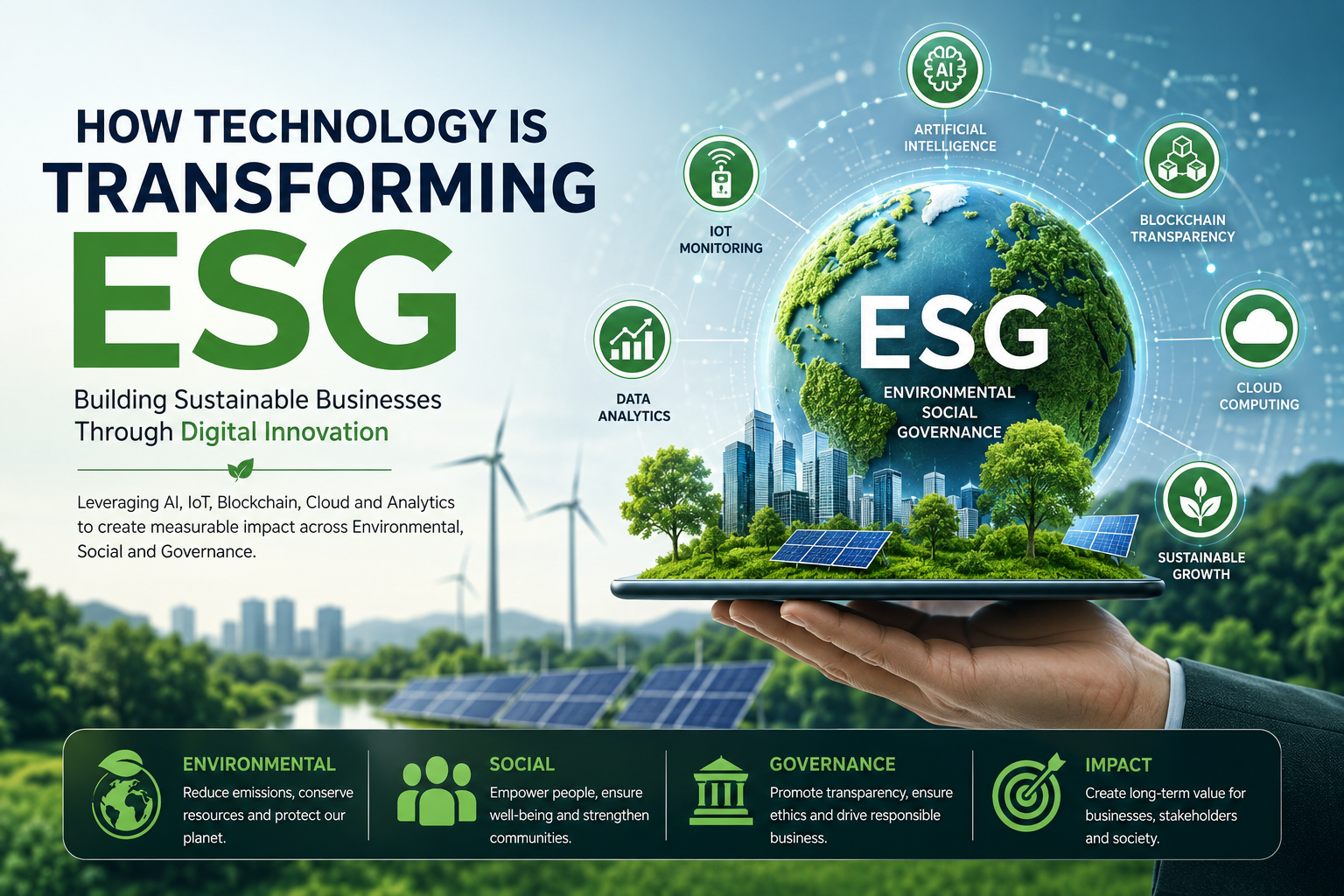
ESG Digital Transformation
Sustainability Needs Technology More Than Ever
Environmental, Social, and Governance (ESG) has become one of the most influential business priorities across industries. Investors demand transparency, governments continue introducing stricter regulations, customers prefer responsible brands, and organizations increasingly recognize sustainability as a competitive advantage rather than simply a compliance requirement.
While ESG ambitions continue to grow, many organizations struggle to measure, monitor, and improve their sustainability performance using traditional reporting methods. Manual data collection, disconnected systems, spreadsheets, and delayed reporting make it difficult to generate reliable ESG insights.
Modern technologies such as Artificial Intelligence (AI), Internet of Things (IoT), Blockchain, Cloud Computing, GIS, Satellite Intelligence, and Advanced Analytics are transforming ESG from periodic reporting into continuous, data-driven decision making.
Why ESG Matters
ESG Has Become A Business Imperative
Investor Confidence
Investors increasingly evaluate organizations based on sustainability performance, climate commitments, governance practices, and long-term resilience.
Regulatory Compliance
Governments worldwide are introducing stricter sustainability reporting requirements, making accurate ESG data essential.
Customer Trust
Consumers prefer organizations that demonstrate responsible environmental practices and transparent governance.
Operational Efficiency
ESG initiatives often reduce operational costs by improving energy efficiency, reducing waste, and optimizing resources.
Risk Management
Continuous ESG monitoring enables organizations to identify environmental and governance risks before they become critical.
Long-Term Growth
Sustainable organizations attract better investments, stronger partnerships, and improved brand reputation.
ESG Challenges
Why Traditional ESG Programs Often Fail
Despite strong sustainability ambitions, many organizations continue to rely on manual reporting processes and fragmented information systems. This limits visibility and prevents real-time decision making.
- Manual spreadsheet-based reporting
- Disconnected business systems
- Limited carbon emission visibility
- Delayed sustainability reporting
- Poor supply chain transparency
- Difficulty verifying ESG claims
- Inconsistent compliance documentation
- High reporting costs
Digital technologies eliminate these challenges by enabling automated data collection, continuous monitoring, predictive analytics, and transparent reporting.
Artificial Intelligence
AI Makes ESG Smarter
Artificial Intelligence enables organizations to analyze massive volumes of environmental and operational data, identify sustainability risks, and generate predictive insights that support better business decisions.
Predictive Analytics
Forecast energy consumption, emissions, equipment failures, and sustainability trends before they occur.
Carbon Intelligence
Calculate carbon footprints and recommend opportunities for emission reduction.
Compliance Automation
Automate ESG reporting and identify compliance gaps through intelligent document analysis.
Internet of Things
Real-Time Environmental Monitoring
IoT sensors continuously collect environmental data, enabling organizations to monitor sustainability metrics without manual intervention.
Continuous monitoring enables organizations to respond immediately to anomalies while improving operational efficiency and environmental performance.
Blockchain Technology
Transparency Builds Trust
Blockchain creates immutable records that improve trust, transparency, and accountability across ESG reporting and sustainable supply chains.
Carbon Credits
Secure verification and trading of carbon credits with complete transparency.
Supply Chain Traceability
Track materials and products throughout their lifecycle while ensuring ethical sourcing.
Digital Compliance
Maintain tamper-proof ESG records for audits and regulatory reporting.
Cloud Computing
Cloud Platforms Accelerate ESG Transformation
Cloud computing provides the scalability, resilience, and flexibility required to support enterprise ESG initiatives. Organizations can consolidate sustainability data from multiple locations, departments, and business units into a centralized platform, enabling real-time reporting, collaboration, and analytics.
Centralized ESG Data
Aggregate sustainability data from multiple business systems into a single source of truth.
Scalable Infrastructure
Support growing ESG initiatives without investing in expensive on-premise infrastructure.
Business Continuity
Ensure secure access, disaster recovery, and uninterrupted availability of ESG platforms.
GIS & Remote Sensing
Satellite Intelligence for Environmental Monitoring
Modern ESG programs increasingly leverage Geographic Information Systems (GIS), drone imagery, and satellite data to monitor environmental conditions with exceptional accuracy.
These technologies significantly improve the accuracy of sustainability reporting while reducing manual inspections and operational costs.
Data Analytics
Turning ESG Data Into Actionable Intelligence
Collecting ESG data is only the first step. Advanced analytics transform raw environmental, operational, and governance data into strategic insights that support executive decision-making.
Executive Dashboards
Interactive dashboards provide real-time visibility into sustainability KPIs.
Predictive Insights
Forecast future ESG trends using AI-driven analytics and machine learning.
Performance Tracking
Measure carbon reduction, resource utilization, and compliance metrics continuously.
Digital Twin Technology
Simulate Sustainability Before Implementation
Digital Twins create virtual models of assets, infrastructure, and industrial operations, allowing organizations to evaluate sustainability improvements before implementing physical changes.
- Energy optimization
- Manufacturing efficiency
- Smart buildings
- Utility management
- Transportation optimization
- Industrial asset monitoring
Technology Across ESG
How Technology Supports Every ESG Pillar
Environmental
Carbon accounting, renewable energy integration, emission monitoring, waste management, biodiversity analysis, climate intelligence, and environmental reporting.
Social
Employee engagement, workplace safety, learning platforms, accessibility, diversity reporting, community impact measurement, and digital inclusion initiatives.
Governance
Compliance automation, cybersecurity, policy management, audit trails, blockchain verification, regulatory reporting, and enterprise risk management.
Industry Applications
ESG Technology Across Industries
Manufacturing
Energy optimization, emissions monitoring, and predictive maintenance.
Agriculture
Satellite monitoring, precision farming, biodiversity assessment, and carbon measurement.
Financial Services
ESG reporting, sustainable investment analytics, and compliance automation.
Government
Smart governance, environmental monitoring, digital public infrastructure, and climate initiatives.
Energy & Utilities
Renewable energy optimization, smart grids, and operational sustainability.
Healthcare
Green healthcare operations, digital governance, and sustainable facility management.
Future Outlook
The Future of ESG is Intelligent, Connected & Automated
The next generation of ESG will be driven by AI Agents, autonomous monitoring systems, Generative AI, digital twins, edge computing, and real-time analytics. Organizations that embrace intelligent technologies today will be better positioned to meet future regulatory requirements, improve operational resilience, and strengthen stakeholder trust.
Why Axentis
Technology Partner for Sustainable Digital Transformation
AI & Machine Learning
Intelligent ESG analytics, predictive insights, and automation platforms.
Blockchain Solutions
Transparent ESG reporting, carbon credit management, and supply chain traceability.
Cloud & DevOps
Scalable ESG infrastructure with continuous monitoring and operational excellence.
GIS & Remote Sensing
Satellite intelligence, biodiversity monitoring, and environmental assessment solutions.
Frequently Asked Questions
ESG Technology FAQs
How does AI improve ESG reporting?
AI automates data collection, predicts sustainability trends, detects anomalies, and improves reporting accuracy while reducing manual effort.
Why is Blockchain important for ESG?
Blockchain creates secure, tamper-proof records that improve transparency across supply chains, carbon markets, and compliance reporting.
Can ESG monitoring be automated?
Yes. IoT sensors, satellite imagery, AI, and cloud platforms enable continuous monitoring of environmental, operational, and governance metrics.
Conclusion
Technology is the Foundation of Effective ESG
ESG is no longer a reporting exercise—it is a continuous, technology-driven business strategy. Organizations that adopt AI, IoT, Blockchain, Cloud Computing, GIS, and advanced analytics gain better visibility, stronger compliance, improved operational efficiency, and measurable sustainability outcomes.
As ESG expectations continue to evolve, technology will remain the key enabler of responsible growth, transparent governance, and long-term resilience. Businesses that invest in intelligent digital transformation today will be better equipped to create lasting value for stakeholders while contributing to a more sustainable future.
Ready to Build a Technology-Driven ESG Strategy?
Partner with Axentis Technologies Pvt. Ltd. to design intelligent ESG solutions powered by Artificial Intelligence, Blockchain, Cloud Computing, GIS, IoT, and advanced analytics.
![]() 99%
Focused on delivering reliable and business-driven experiences
![]() 10+
Industries transformed through intelligent digital solutions and automation.
