Staff Augmentation vs Project Delivery vs a Scoped Pilot: Which Fits Your Stage?
Choosing the right engineering engagement model affects control, cost predictability, delivery risk and how quickly you can move.
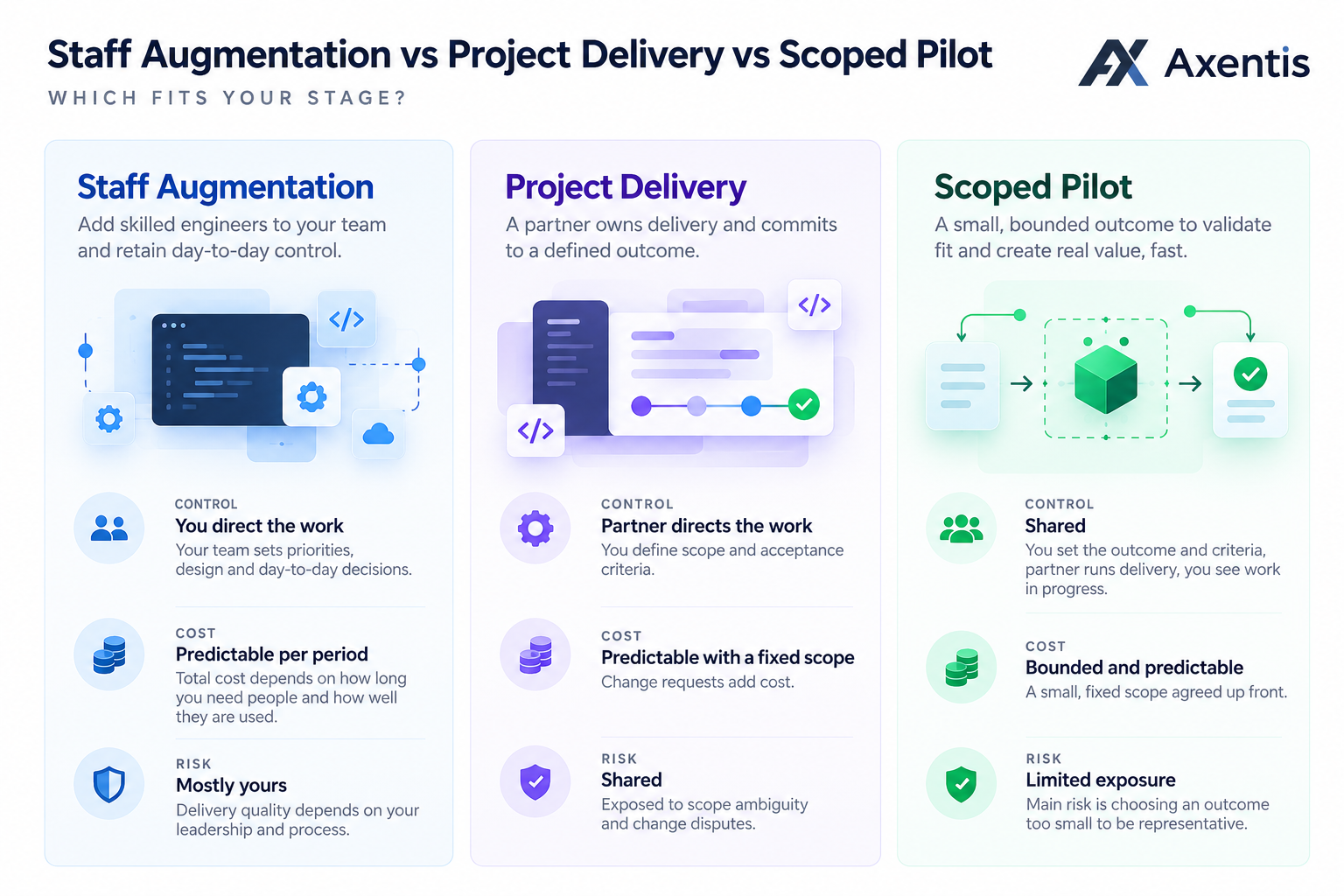
When you need more engineering capacity, the first question is usually “who?” A better first question is “how?” The engagement model you pick shapes who makes the daily decisions, how predictable the spend is, how fast work starts and who carries the risk when things go sideways.
This guide compares staff augmentation vs project outsourcing (which we call project delivery here) and adds a third option many buyers skip: a scoped pilot. It is written for CTOs, founders and product leads in the US, UK, Canada and Australia weighing an engineering partner. We sell scoped delivery at Axentis, so we will also say plainly when staff augmentation is the better choice.
The one question that decides it: who directs the day-to-day engineering?
Start with control, not cost. Ask who will decide, every day, what gets built next, how it is built and whether it is good enough.
Staff Augmentation
If your team will direct the work, you are buying capacity. That points to staff augmentation.
Project Delivery
If you want a partner to own an agreed outcome, you are buying delivery. That points to project delivery.
Scoped Pilot
If you are not yet sure which you need, or whether this partner can do either, you are buying evidence. That points to a scoped pilot first.
Every other trade-off — cost predictability, ramp-up and risk — follows from that answer.
When it works and what it demands of your team
With staff augmentation, a partner provides engineers who join your team, work in your tools and follow your processes. You set priorities, review code and manage the work. The partner handles hiring, employment and replacement.
It works well when:
- You already have strong engineering leadership, a clear architecture and a working delivery process.
- Your backlog is well understood and the gap is simply hands, or a specific skill your team lacks.
- The need is ongoing or open-ended rather than a single outcome with an end date.
- You want to keep direct technical control and fold the extra engineers into your own rhythm.
It also demands real things from you. Someone senior has to onboard the new engineers, answer their questions, review their work and keep them pointed at the right problems. If that person is already stretched, augmented engineers wait, guess or drift, and the cost of that lands on you. Staff augmentation tends to fail when it is used to fill a leadership gap rather than a capacity gap.
With the leadership and process in place, it is a flexible, fair model and often the right call. We would tell you so.
When a fixed outcome makes sense and where fixed bids break
With project delivery, a partner commits to a defined outcome: a product, a feature set or a system change. The partner manages the team, the plan and the day-to-day decisions within the agreed scope. You define what “done” means and accept the result.
It works well when:
- The outcome can be described clearly, with acceptance criteria both sides can test.
- You lack the in-house bandwidth to manage engineers day to day.
- You want spend tied to an outcome rather than to hours.
Fixed bids break in predictable ways. Requirements that seemed clear turn out to be fuzzy. Discoveries mid-build change the shape of the work. Change requests pile up, and every one becomes a negotiation. The cure is not to avoid project delivery but to scope it honestly: explicit in-scope and out-of-scope lists, written assumptions and a change process agreed up front.
A bounded first outcome before you commit to a model
A scoped pilot is a short, paid, fixed-scope engagement that delivers one real outcome under normal working conditions. It borrows the outcome focus of project delivery but keeps the scope small enough that both sides can learn quickly and cheaply. We covered the mechanics in detail in our guide to paid pilot projects.
A pilot answers questions neither of the other models answers up front:
- Can this partner understand your product, your stack and your stakeholders?
- Do they raise problems early and communicate honestly across time zones?
- After seeing them work, would you rather direct them (augmentation) or hand them an outcome (delivery)?
Good pilot outcomes are real and bounded: a self-contained web feature or internal tool (custom software development), a mobile MVP release slice shipped as a beta build to testers (mobile app development), an assistive AI feature where a person reviews and approves the output (AI/ML development), or a CI/CD and monitoring improvement on an existing system (DevOps & SRE services).
A pilot is not the right tool for everything. If you already know the partner well, or you simply need two more engineers on a mature team next week, a pilot may add a step you do not need.
Staff augmentation vs project delivery vs a scoped pilot
| Factor | Staff augmentation | Project delivery | Scoped pilot |
|---|---|---|---|
| Control | You direct priorities, design and daily work. | Partner directs daily work; you own scope and acceptance. | Shared: you set the outcome and criteria, partner runs delivery, you see work in progress. |
| Cost predictability | Predictable per period; total depends on how long you need people and how well they are used. | Predictable if scope is stable; change requests add cost. | Bounded by a small, fixed scope agreed up front. |
| Ramp-up | Depends on your onboarding: access, context and a senior person’s time. | Needs a discovery and scoping phase before building. | Short scoping, then a focused build on one outcome. |
| Risk | Mostly yours: delivery quality rides on your leadership and process. | Shared via contract, but exposed to scope ambiguity and change disputes. | Limited exposure; the main risk is choosing an outcome too small to be representative. |
| Best-fit situations | Strong in-house leadership, known backlog, ongoing need or a specific skill gap. | Clear, testable outcome; limited bandwidth to manage engineers. | New partner, uncertain model, or a first outcome you want shipped and owned. |
| When it fails | Used to cover a leadership gap; no one has time to direct or review the work. | Fuzzy requirements, frequent pivots or a price squeeze that erodes quality. | Scope creeps, or no decision is made at the end and it drifts into open-ended work. |
A decision guide by stage
Pre-seed or idea stage
You probably have no in-house engineering lead yet, so staff augmentation leaves nobody to direct the work. A scoped pilot that ships one core journey, or a tightly scoped project, usually fits better.
Post-MVP
You have a product, some users and a growing backlog, but the team is thin. A pilot on a representative feature lets you test a partner inside your real codebase before choosing between augmentation and a larger delivery scope.
Scaling product
You have engineering leaders and a working process. Staff augmentation is often the most efficient way to add capacity or a niche skill. Project delivery still suits well-bounded workstreams, such as a new platform component or a release-readiness overhaul, that you would rather not manage directly.
How to move from a pilot into a longer engagement without starting over
A pilot only saves time if what you learn carries forward. Set it up so the next step is a continuation, not a restart.
- Own everything from day one. Code in repositories you control, cloud resources in your accounts, documentation you keep.
- Keep the same people. The engineers on the pilot should be the ones you get afterwards.
- End with a written decision. Scale, adjust or stop, plus the model for the next phase: augmentation, delivery or a mix.
- Turn notes into a backlog. Ideas parked during the pilot become the starting backlog for phase two.
That is how we run our Launch Pilot at Axentis: private scoping, written acceptance criteria, one bounded outcome across web, mobile, AI/ML or DevOps, your ownership throughout, and a clear decision point with a path to scale if you choose it.
Frequently Asked Questions
Is staff augmentation cheaper than project outsourcing?
Not inherently. Staff augmentation can look cheaper per period, but the total cost depends on how well you direct the engineers and how long you need them. Project delivery can look pricier up front but bundles management and delivery risk. Compare total cost of reaching the outcome, including your own team’s time.
Can I combine staff augmentation and project delivery?
Yes, and many teams do. A common pattern is augmenting your core product team while a partner delivers a well-bounded workstream separately. Be clear about who owns decisions in each.
When should I skip the pilot?
If you have already worked with a partner and trust their delivery, or you simply need extra engineers inside a mature team, a pilot may add little. It earns its place when the partner, the model or the outcome is still uncertain.
Who owns the code in each model?
You should, in every model. Make sure the contract assigns IP to you and that code and infrastructure sit in accounts you control from the start.
Not sure which model fits?
If you are deciding between staff augmentation, project delivery and a scoped pilot, talk to an expert at Axentis. We will talk through your stage, team and goals privately, and if a pilot is not the right fit, we will say so.
![]() 99%
Focused on delivering reliable and business-driven experiences
![]() 10+
Industries transformed through intelligent digital solutions and automation.
