The Real Cost of Outsourcing Software Development to India
The hourly rate is only one part of the equation. Understand the hidden costs, delivery risks and practical controls that help businesses get more value from an offshore software development partnership.
The hourly rate is often the first number businesses compare when evaluating an offshore software development partner. However, it tells you very little about the total effort required to deliver working, accepted and maintainable software. The actual cost includes the partner’s fees, your team’s management time, onboarding, communication, quality assurance, rework and the effort required to maintain control of the product over time. Two development partners with different hourly rates can produce similar total costs once coordination and rework are considered. The more useful question is not simply how much an hour costs, but how much it takes to achieve the agreed outcome. Several costs are easy to overlook when reviewing a proposal. Identifying them before development begins helps both sides plan a more predictable engagement. Your team must answer questions, set priorities, review work and accept deliverables. This time is a real cost, even when it never appears on the vendor’s invoice. Define who owns product decisions and how much day-to-day coordination your team will provide. Distributed teams rely on written requirements, recorded walkthroughs and documented decisions. Ambiguous instructions can lead to misunderstandings and unnecessary rework. Agree on communication channels, response expectations and a shared definition of done. Working across time zones can create delays when decisions depend on live conversations. It can also enable asynchronous progress when tasks and questions are well organised. Protect regular overlap hours for reviews and keep important decisions in writing. A new team needs time to understand your product, codebase, architecture, business domain and development conventions. Provide structured documentation, access to the right environments and a clear onboarding plan. Unclear requirements, late changes and insufficient testing can increase the effort needed to complete a feature. Define acceptance criteria before development and make testing part of every delivery cycle. When architecture decisions, environment setup and deployment procedures exist only in individual team members’ knowledge, transitions become expensive. Make runbooks, setup instructions and decision records part of ongoing delivery. A successful outsourcing engagement must also protect your intellectual property, data, operational continuity and ability to change partners when necessary. Clarify ownership of source code, designs, documentation and data in the contract. Establish confidentiality terms, appropriate access controls, secure credential management and a process for revoking access when team members leave the project. Contracts should explain deliverables, acceptance procedures, change control, termination terms and handover obligations. Ask how disagreements about scope or completion will be resolved before work starts. Cross-border engagements can involve exchange-rate movements, transfer fees, payment schedules and jurisdiction-specific tax or reporting requirements. Confirm the relevant arrangements with your finance or tax adviser before signing. If repositories, cloud accounts, domains or third-party services are controlled exclusively by the vendor, transitioning to another team may become unnecessarily difficult. Keep critical accounts under your company’s ownership from day one and provide the development partner with appropriately scoped access. Clear ownership, measurable acceptance criteria and a structured delivery process help reduce uncertainty throughout the engagement. Begin with a small, bounded piece of real work. Evaluate communication, estimation, code quality and delivery discipline before making a larger commitment. Specify what each deliverable must do, how it will be tested and who will approve it. Distinguish defects from requests that change the agreed scope. Agree on testing responsibilities, required test coverage and how results will be shared. Include quality assurance in the delivery plan and budget. Assign a product owner, document decisions, batch questions and schedule regular demonstrations of working software. Create your own source-code repositories, cloud accounts, domains and third-party service accounts. Grant access to the partner rather than transferring ownership. Require architecture notes, infrastructure configuration, runbooks, known issues and deployment instructions as part of normal delivery. The right engagement model depends on your internal team’s capacity, the clarity of your requirements and how much delivery responsibility you want the partner to assume. Suitable when you already have engineering leadership and delivery processes in place and need additional skills or capacity. Cost consideration: Your team retains more responsibility for day-to-day management, prioritisation and integration. Suitable for well-defined deliverables where responsibilities, scope, milestones and acceptance conditions can be agreed in advance. Cost consideration: Clear scope and change-control rules help manage expectations and delivery effort. Suitable when you want to evaluate a partner’s delivery process on a bounded piece of real work before committing to a larger engagement. Cost consideration: The pilot is a separate investment that helps inform the next decision; it does not eliminate every delivery risk. For a detailed comparison, read our guide to staff augmentation vs project outsourcing. At Axentis, our Launch Pilot is designed around a defined outcome, written scope, acceptance criteria agreed before development, client-owned repositories and accounts, and a clear handover and decision point. This gives both sides a structured way to evaluate the work, review progress and decide whether to stop, extend the engagement or move into ongoing delivery. The goal is not to promise that every project will cost less. It is to make the work, responsibilities, ownership and delivery expectations clear before a larger commitment is made. Learn how a bounded engagement can help you evaluate a development partner. Understand how to define scope, acceptance criteria and change control for an MVP. Explore the ownership, documentation and operational access required for a smooth transition. The total cost includes the development partner’s fees plus internal management time, communication, onboarding, rework, quality assurance and long-term maintenance. The final amount depends on the scope, team structure, delivery model and quality of project governance. Common examples include management overhead, unclear requirements, repeated onboarding, additional testing, knowledge transfer and rework. These costs can be reduced through better planning and clearly defined responsibilities. Start with a scoped paid pilot, define acceptance criteria before development, keep repositories and accounts under your control, document key decisions and establish a clear handover process. It can be managed with agreed overlap hours, written decisions, asynchronous updates and scheduled reviews. The appropriate working arrangement depends on the countries and teams involved. Ownership and access rights should be clearly documented in the contract. A common approach is for the client to own the repositories and critical service accounts, with the development partner receiving the access required to perform its work. Not on hourly rate alone. Compare relevant experience, delivery processes, testing, communication, ownership terms and the total effort required to reach an accepted outcome. If you’re considering an India-based engineering partner, Axentis can help you scope a bounded outcome, agree on acceptance criteria and establish a clear handover path before you commit to a larger engagement.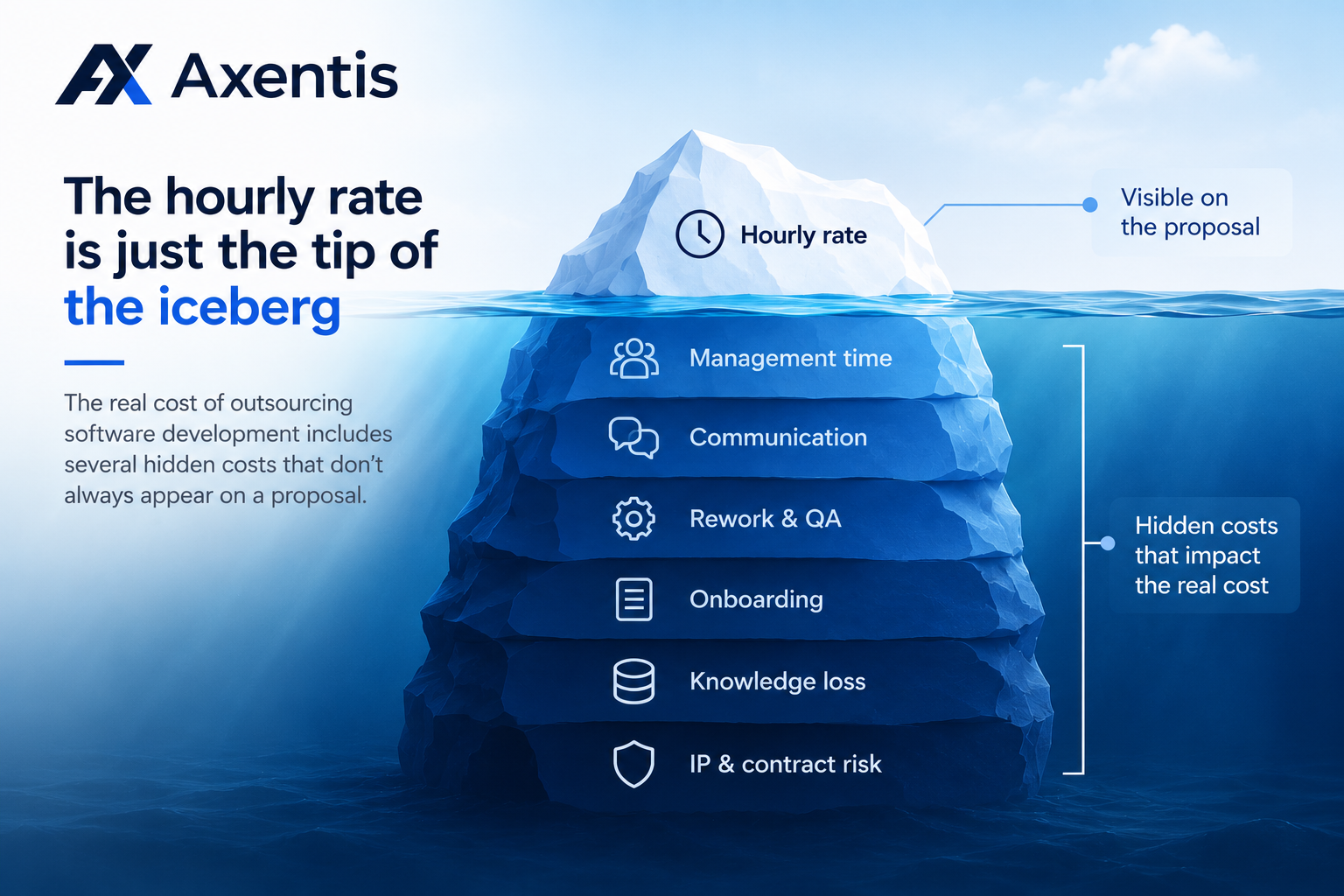
Why the Hourly Rate Is the Wrong Starting Point
The Hidden Costs of Outsourcing Software Development
1. Management Time
2. Communication Overhead
3. Time-Zone Coordination
4. Onboarding and Ramp-Up
5. Rework and Quality Assurance
6. Attrition and Knowledge Loss
Costs Are Only Part of the Equation
Intellectual Property and Security
Contract and Exit Risk
Currency, Payments and Tax
Vendor Lock-In
How to Reduce Outsourcing Costs and Risks
Start With a Scoped Paid Pilot
Define Acceptance Criteria
Make Testing Visible
Establish a Communication Rhythm
Keep Accounts Under Your Control
Plan Handover From Day One
Staff Augmentation, Project Delivery or a Paid Pilot?
Staff Augmentation
Project Delivery
Scoped Paid Pilot
Build Cost Transparency Into the Engagement
Continue Your Research
Paid Pilot Projects
Fixed-Scope MVP Planning
Software Project Handover
FAQs About Outsourcing Software Development to India
What is the real cost of outsourcing software development to India?
What are the biggest hidden costs?
How can I reduce outsourcing risk?
Is the time-zone difference between India and other countries a problem?
Who should own the source code and cloud accounts?
Should I choose the lowest-cost development partner?
Evaluate the Delivery Before Making a Bigger Commitment
![]() 99%
Focused on delivering reliable and business-driven experiences
![]() 10+
Industries transformed through intelligent digital solutions and automation.
