How to Scope an AI Pilot That Ends in a Decision, Not a Demo
Most AI pilots do not fail loudly. They end with a polished walkthrough and no clear next step, because nobody agreed in advance what “worked” would mean. If you are a CTO, founder or product lead with an AI mandate, the fix is not a better model. It is a better scope.
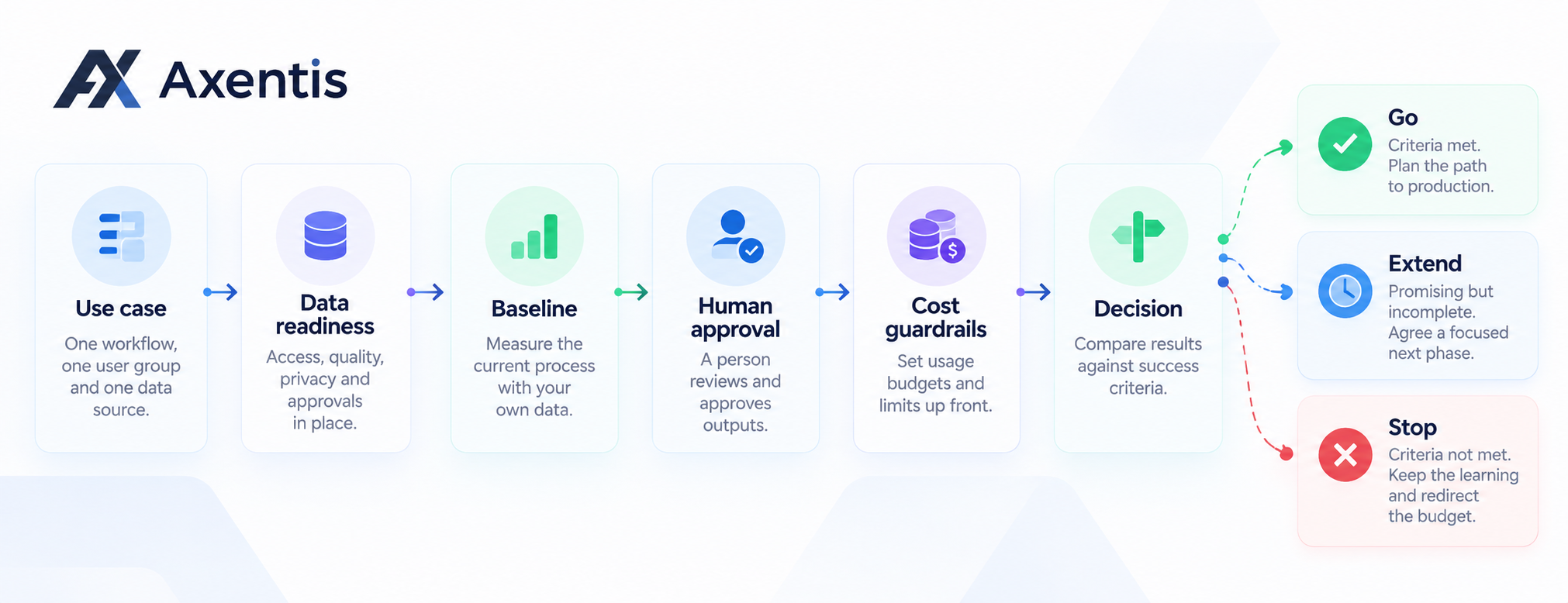
This guide explains how to scope an AI pilot so that it ends in a decision you can defend: go, extend or stop. It closes with a scoping checklist you can use with your own team or with any vendor, including us.
Why AI pilots stall: scope too broad, no baseline, no owner
When an AI pilot drifts, the cause is usually visible in the first scoping document:
- The scope is too broad. “Use AI to improve customer support” is a direction, not a pilot. A broad brief invites a prototype that proves nothing in particular.
- There is no baseline. If you do not know how long a task takes today, how often it goes wrong or what it costs, you cannot say whether an AI-assisted version is better.
- There is no owner. Someone needs to own the workflow, the success criteria and the final call. Without that person, nobody on the business side is accountable.
A demo answers “can this be built?” A well-scoped pilot answers “should we keep investing, and on what terms?”
Pick one workflow, one user group and one data source
The narrower the starting point, the clearer the result. A good use case has:
- One workflow. A specific, repeated task, such as triaging inbound tickets, extracting fields from documents, drafting first replies or summarising case notes for a reviewer.
- One user group. A named team who will actually use the output and give feedback, not “the whole company”.
- One data source. A single system or dataset you can access, describe and legally use for the purpose.
Write the use case in two or three sentences: who does the task today, what the AI will assist with, and who reviews the result. If you cannot, the scope is not ready. Also state what the pilot will not touch.
Check data readiness before you commit
Data problems are easier to find during scoping than mid-build. Answer these first:
- Can the team get access to the data in the pilot window, with the right approvals?
- Is there enough representative data, including messy and edge cases, to test against?
- Does it contain personal, confidential or regulated information, and how will that be handled?
- Who owns the data, and are there contractual limits on sending it to third-party model providers?
- Is there a set of real examples with known correct answers you can use for evaluation?
If the honest answer to most of these is “not yet”, the right first step may be a data-readiness exercise rather than an AI pilot.
Measure the current process before building anything
Success criteria only mean something against a starting point. Before any model is wired up, record how the workflow performs today. Depending on the use case, that might be time per task, error or rework rate, backlog size, turnaround time or how often work is escalated. Use your own numbers; no industry benchmark substitutes for them.
Then turn the baseline into success criteria that are specific and testable. For example: “Reviewers accept the AI-drafted summary with minor edits on most cases in the evaluation set, and average handling time drops compared with the measured baseline.” Add quality thresholds that would count as a failure regardless of speed, such as any instance of the system inventing a fact in a customer-facing draft that a reviewer did not catch in testing.
Design the human review and approval step from day one
AI in a pilot should be assistive. It drafts, classifies, extracts or suggests; a person reviews and approves before anything is sent, saved or acted on. That is what makes the pilot safe to run on real work and its results trustworthy.
Design this step as part of the scope:
- Who approves. Name the role that reviews each output and has authority to accept, edit or reject it.
- What they see. Show the source material alongside the AI output so reviewers can check it quickly.
- What gets logged. Record accept, edit and reject decisions. Those corrections are your most useful evaluation data.
- What never happens automatically. List the actions that always need a human: customer messages, payments, record changes and anything released to production.
For agent-style pilots this matters even more. Our AI agent development work follows the same principle: agents prepare, people approve.
Set cost guardrails before the first API call
AI pilots carry running costs: model usage, hosting, storage and reviewer time. All of them should be bounded. Agree in writing:
- A usage budget for model and infrastructure costs during the pilot, with alerts well before it is reached.
- Who can approve going over it, and what happens if nobody does (the pilot pauses rather than spending silently).
- How much reviewer time the pilot will need each week, since that is a real cost to your team.
- A rough view of what running costs would look like at production volume, so a “go” decision is not made blind.
Define go, extend or stop criteria up front
This is the step that turns a demo into a decision. Before the build starts, write down what each outcome looks like:
- Go. Success criteria are met against the baseline, the review step works in practice, costs stay inside guardrails and the projected running cost is acceptable. You plan the path to production.
- Extend. Results are promising but incomplete, for example because one data source was weaker than expected. You agree a specific, time-boxed extension with a named question to answer, not an open-ended continuation.
- Stop. The criteria are not met, the data is not good enough or the economics do not work. You keep the baseline, the evaluation set and the learning, and you redirect the budget.
A stop is a legitimate result. A pilot that cleanly rules out a bad investment has done its job.
Plan the path to production: integration, permissions, cost and audit
A “go” decision should not be followed by a surprise rebuild. Even inside the pilot, note what production would require: integration with your systems of record, access permissions, logging and audit trails, monitoring for quality drift, rollback and an owner for ongoing operation. Production readiness is its own discipline; our DevOps and SRE services cover the pipelines, observability and release controls that an AI feature needs before real users depend on it.
AI pilot scoping checklist
Use this as a one-page decision framework before you approve any AI pilot:
| Area | Question to answer in writing |
|---|---|
| Use case | Which single workflow, user group and data source? What is explicitly out of scope? |
| Owner | Who owns the workflow, the success criteria and the final decision? |
| Data readiness | Is access approved, is the data representative, and are privacy and contract limits understood? |
| Baseline | How does the current process perform today, measured with your own data? |
| Success criteria | What specific, testable result counts as success, and what counts as failure regardless of speed? |
| Human approval | Who reviews each output, what is logged, and which actions always need a person? |
| Cost guardrails | What is the usage budget, who approves overruns, and what are projected production costs? |
| Go / extend / stop | What does each outcome look like, and when is the decision meeting? |
| Path to production | What integration, permissions, audit and monitoring would a “go” require? |
If any row is blank, the pilot is not ready to start.
How Axentis approaches AI pilots
We scope AI work through our Launch Pilot, using the same structure as this checklist: one bounded outcome, written success criteria, a designed human approval step, agreed cost limits and a decision point at the end. You own the code, the evaluation set and the documentation. If you want the wider background on how a paid pilot works, read our guide to paid pilot projects, and our comparison of staff augmentation vs project outsourcing vs a scoped pilot if you are still choosing an engagement model. For the full scope of our AI work, see AI/ML development.
Frequently Asked Questions
How long should an AI pilot run?
Long enough to test the workflow on real cases, gather reviewer feedback and compare results with the baseline. That is usually weeks rather than months, but agree the length during scoping rather than picking a number first.
What is the difference between an AI proof of concept and an AI pilot?
A proof of concept usually checks technical feasibility on sample data. A pilot tests the approach inside a real workflow, with real users, a human review step and success criteria tied to a measured baseline, so it can support a business decision.
Should an AI pilot ever act without human approval?
Not for anything with external effects. In a pilot, AI should draft, classify, extract or suggest, and a person should approve customer messages, record changes, payments and releases. Any later automation should be a separate, deliberate decision based on evidence.
Ready to scope your AI pilot?
If you have an AI use case and want a pilot that ends in a clear go, extend or stop decision, talk to an expert at Axentis. We will scope it privately with you around one workflow, your data and your approval process, with no obligation to go further.
![]() 99%
Focused on delivering reliable and business-driven experiences
![]() 10+
Industries transformed through intelligent digital solutions and automation.
